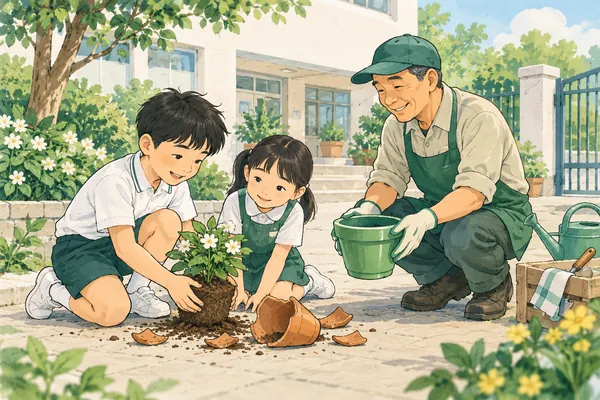
A child may understand the pictures but still struggle to turn them into sentences. Start by helping them explain what happens. Four guiding questions give the story a shape before the child has to think about every English word.
Read the pictures as one event
Look at all the pictures before writing. Ask your child to point out the people, place, actions and visible clues. A facial expression may suggest a feeling; ask what in the picture supports that idea.
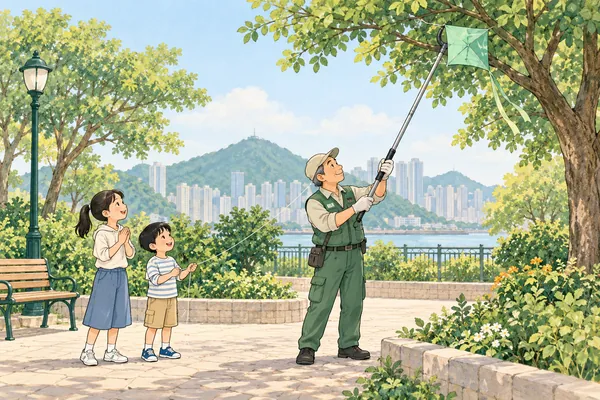
If a kite is flying, then caught in a tree, and a keeper arrives with a pole, the pictures show a problem and a response to it. Let your child tell that sequence aloud first. They can use the language they are comfortable with while planning.
Make brief notes with four questions
Begin with keywords. Turn those notes into complete English sentences after the ideas are clear. Children may choose names and small details, provided they fit the pictures and the task.
- Who is in the story? Identify the main people.
- Where does the story happen? Name the setting.
- What happens? Identify the main event and any problem the characters face.
- How can the story end? Decide what happens next and, if needed, how the problem is handled.
Worked example: a kite in a tree
This is a separately written example. Imagine a task about yesterday with three pictures: Ella flying a kite at the park, the kite caught in a tree, and a park keeper holding a long pole.
The planning notes could be: Ella and her brother; at the park; a kite in a tree; ask the park keeper for help and say thank you. The child can now turn those notes into a short sequence.
Your turn: say it, then write it
Use the four questions to make notes about the scene below. Then write two or three sentences explaining the event and its ending. Once the meaning is clear, choose one language feature to check, such as capital letters or the tense requested by the task.
Try it yourself
Original scene: Tom opens his crayon box in the classroom. The box falls onto the floor. His classmate May helps him pick up the crayons.
- Who is in the story, and where are they?
- What happens?
- Write one English sentence to end the story. Keep it connected to the event.
Show an explained answer
- The people can be Tom and May, and the setting is their classroom. The problem is the fallen box and the scattered crayons.
- One possible ending is: Tom thanked May and put the crayons back in the box.
- Another ending could have them finish tidying and get ready for the lesson. Look for a clear response to the same problem, rather than one exact sentence.